Meta Ads for Supplements USA
The level of competition in the supplements industry in the United States is extremely intense; therefore, there is no way that any company will be able to depend only on its organic social media presence. Meta Ads for supplement brands to reach out to their prospective customers on Facebook and Instagram. However, successful Meta Ads for supplements USA marketing campaigns take more than just increasing budget allocations.
Creativity testing, targeting the audience, conversion tracking, and optimizing the landing page all contribute to effective campaigns. Supplement ads in the USA should be approached by brands using the right information, no false claims about health benefits and complying with Meta’s advertising policies and relevant USA regulations.
Why Meta Ads Matter for Supplement Brands in the USA?
For many U.S supplement companies, Meta is still a crucial paid social media platform since it offers chances to present items, inform viewers, and motivate website actions through visual advertising.
Reach Potential Customers across Facebook and Instagram
Supplement brands can employ image, video, carousel, and other available advertising formats on Facebook and Instagram to target potential consumers. People who might not have found the brand through organic content alone can be introduced to a product through a carefully planned campaign.
Build Awareness for New Supplement Brands
Before expecting customers to make a purchase, the U.S. supplement businesses frequently need to gain notoriety. The brand’s concept, product format, and overall value proposition can all be introduced through awareness campaigns.
Generate Direct-to-Consumer Sales
By directing qualified prospects to product pages or other conversion-focused websites, meta advertising can also help with direct-to-consumer sales. In order for brands to determine whether advertising is producing significant commercial results, tracking should go beyond clicks.
Retarget Interested Shoppers
A person who engages with a brand, sees a video, or views a product page may already be more aware than a new prospect. When the appropriate Meta tools and audience indications are available, retargeting can assist brands in re-establishing contact with these audiences.
Support Product Launches and Promotions
Seasonal promotions, new product launches, and other marketing efforts can all be supported by meta campaigns. To determine which messages provide stronger engagement and conversion signals, many creative concepts can be evaluated.
How Meta Ads Work for U.S. Supplement Brands
Rather than relying on a single ad to accomplish every marketing goal, a strong meta strategy should represent the entire consumer journey.
Awareness: Introduce Your Supplement Brand
The main emphasis at this stage is on introducing the brand of supplements and the products to prospective consumers. The product category, brand story, formulation, or key differentiators can be showcased using the creatives.
Consideration: Educate Potential Customers
Prior to making a purchase, consumers often tend to search for some kind of research. They may investigate the quality, composition, contents, instructions for use, and the compatibility of the product with their routine. Without going into exaggerated health claims, advertisements could answer such questions.
Conversion: Turn Interest into Purchases
Ads aimed at conversion may instil desired behaviour such as product-page browsing or purchasing after the consumers get to know about the product. After an engaging ad, a landing page that has relevant product information, clear pricing, and smooth check-out process is required.
Retargeting: Re-Engage Potential Customers
Retargeting refers to a process by which communication is made with people who have been involved with the brand. Rather than showing the same ad repeatedly, the message can be customised according to the past interactions of the individual.
Building a Meta Ads Strategy for Supplement Brands
A successful Meta Ads strategy for supplement brands starts with understanding the U.S. market, choosing the right audience and campaign goals, and creating a clear path from ad engagement to purchase. A structured approach can help brands improve targeting, ad performance, and return on advertising spend.
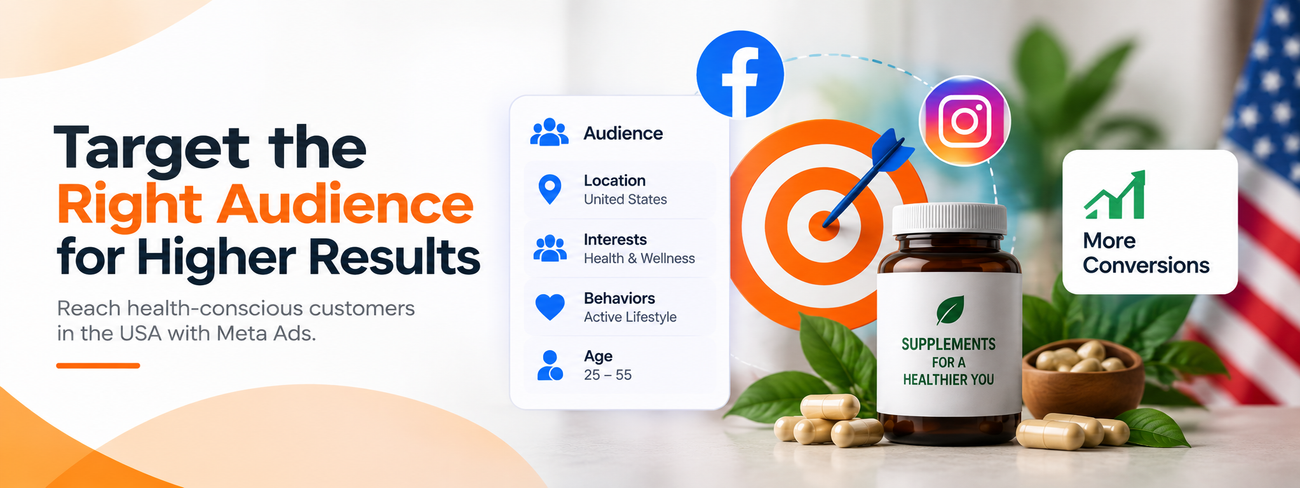
Define Your Ideal U.S. Customer
Start by creating a clear profile of your ideal customer. Consider:
- Age: Identify the age groups most likely to need and purchase your supplement.
- Lifestyle: Consider fitness habits, wellness interests, work routines, and daily behaviours.
- Interests: Use relevant interests and audience signals to reach potential customers.
- Product Needs: Understand what problem or wellness goal your product addresses.
- Buying Behaviour: Consider whether customers are first-time buyers, repeat purchasers, or subscription customers.
- Geographic Targeting: Focus on the U.S. states, cities, or regions that align with your market and customer base.
Define Your Supplement Brand’s Unique Value Proposition
Clearly communicate why customers should choose your supplement brand. Your value proposition could focus on product quality, ingredients, formulation, convenience, sourcing, or another genuine point of differentiation.
Choose the Right Campaign Objective
Select a Meta campaign objective based on your marketing goal. Supplement brands may use campaigns designed to generate awareness, engagement, website traffic, leads, or purchases. For e-commerce brands, conversion-focused campaigns are particularly important when the goal is online sales.
Determine Your Advertising Offer
Give customers a clear reason to take action. Depending on the brand, this could include a first-order discount, free shipping, product bundle, subscription offer, or limited-time promotion. Make sure the offer is genuine and clearly presented.
Build a Full-Funnel Advertising Strategy
Not every potential customer is ready to buy immediately. Use different messaging for each stage of the funnel—from introducing your brand to new audiences, to educating interested shoppers, and retargeting people who have viewed products or visited your website.
Connect Meta Ads with Your E-Commerce Store
Your advertising strategy should connect smoothly with your online store. Ensure product pages load quickly, provide clear product information, make checkout easy, and accurately track purchases. Proper tracking and conversion data can help Meta optimise campaigns and help brands understand which ads are driving sales.
Meta Audience Targeting for U.S. Supplement Brands
An essential part of Meta Ads for supplement brands in the USA is audience strategy. Advertisers shouldn’t assume that all targeting options will always be accessible. Meta is able to modify its targeting guidelines, audience controls, privacy constraints, and advertising offerings.
Broad Audience Targeting
Meta’s distribution system may have greater flexibility in identifying possible clients utilising available signals if it uses broad targeting. When a brand has excellent creative and enough conversion data, it might be worthwhile to explore this strategy.
Interest-Based Audience Targeting
Advertisers can occasionally test audience themes associated with their products with the help of interest-based targeting. However, rather than being reliable markers of purchase intent, interests should be viewed as testing factors.
Custom Audiences
Using eligible first-party data or past interactions, custom audiences can assist marketers in reaching consumers. The data being used and the existing Meta needs determine availability.
Website Visitor Audiences
Since they have previously shown some interest, website visitors can be a valuable remarketing possibility. Depending on platform capabilities and privacy regulations, brands may be able to build suitable audiences based on website activity.
Customer List Audiences
When the information is gathered and utilised properly, customer-list audiences can assist companies in re-establishing contact with current clients or potential clients. Before using consumer information for advertising, brands should make sure that their data procedures meet all relevant regulations.
Retargeting Potential Customers
Customer intent should be taken into consideration while planning retargeting. A person who just saw an awareness video might require a different message than someone who browsed a product page.
Choosing the Right Meta Ad Creatives for Supplement Brands
Creative quality can have a major impact on how supplement ads perform on Meta. U.S. supplement brands should use clear, authentic, and informative visuals that communicate the product’s value without making unsupported health or medical claims.
Product-Focused Images
Use high-quality product images that clearly show the packaging, product format, and key features. Clean visuals can help users quickly understand what is being advertised.
Short-Form Video Ads
Short videos can capture attention quickly and demonstrate the product, explain its features, or introduce the brand. Keep the opening seconds engaging and the message easy to follow.
UGC-Style Content
User-generated content (UGC) can make supplement advertising feel more authentic. Consider creator-style videos that show how the product fits naturally into a customer’s daily routine.
Educational Supplement Content
Educational creatives can explain ingredients, product features, usage instructions, or general wellness information. This approach can help build awareness and trust while providing useful information.
Lifestyle-Based Creatives
Show how the supplement fits into everyday U.S. lifestyles, such as morning routines, workouts, travel, or busy workdays. Lifestyle imagery can make the product more relatable.
Customer Testimonials and Reviews
Authentic customer feedback and reviews can provide social proof. Use genuine testimonials and avoid statements that promise specific medical results or outcomes.
Testing Multiple Creative Concepts
Avoid relying on a single ad concept. Test different formats, hooks, visuals, messages, and calls to action to identify which creatives resonate best with your target audience.
Creative Angles to Test
Supplement brands can experiment with several creative angles, including:
- Educational: Explain an ingredient or wellness topic.
- Ingredient-Focused: Highlight key ingredients and product formulation.
- Lifestyle: Show the product as part of a daily routine.
- Problem/Solution: Address a common customer need without making medical claims.
- Product Demonstration: Show the product, packaging, preparation, or usage.
- Brand Story: Share the brand’s mission, values, sourcing, or product development journey.
Meta Ad Copy and Messaging for U.S. Supplement Brands
For U.S. supplement brands, effective Meta ad copy needs to be persuasive while staying accurate and responsible. Focus on the product’s features, intended benefits, and value without making unsupported health or medical claims.
Start With a Strong Hook
Use the first line to capture attention and encourage users to keep reading. A question, product benefit, ingredient highlight, or relatable wellness message can work well.
Focus on Product Benefits
Explain the intended benefits of the supplement in clear, consumer-friendly language. Focus on what the product is designed to support rather than promising specific health outcomes.
Explain What Makes Your Product Different
Highlight genuine differentiators such as key ingredients, formulation, product format, sourcing, quality standards, or convenience. Give customers a clear reason to consider your brand.
Use Clear Calls to Action
Tell users what to do next with a simple call to action such as Shop Now, Learn More, Explore the Formula, or See the Ingredients.
Build Trust without Making Unsupported Claims
Avoid exaggerated promises, guaranteed results, or language suggesting that a supplement can diagnose, treat, cure, or prevent a disease. Keep claims truthful, supportable, and consistent with applicable advertising requirements.
Aggressive vs. Responsible Messaging
Aggressive claim:
“Stop inflammation and cure your joint pain naturally.”
Responsible benefit-focused message:
“Discover a thoughtfully formulated supplement designed to support everyday wellness and a healthy inflammatory balance.”
The second approach communicates a clear wellness benefit without promising to treat a medical condition or guarantee a specific result.
Meta Ads Compliance for Supplement Brands in the USA
Any supplement advertising effort in the United States should prioritise compliance. Both Meta’s advertising guidelines and any relevant U.S. advertising and supplement regulations must be taken into account by brands.
Avoid Unsupported Health Claims
Advertisements for supplements should refrain from making unsupported, objective claims. Advertising statements related to health must be accurate and properly supported.
Avoid Disease or Treatment Claims
Advertising for supplements should be especially cautious when using language that implies a product can diagnose, treat, cure, or prevent an illness. Such words may raise issues with platform policy and regulations.
Be Careful With Before-and-After Claims
Before-and-after pictures may suggest that clients should anticipate a specific outcome. The way an advertisement is presented can affect how consumers perceive the intended effects of a product, even in the absence of a specific promise.
Use Accurate Product and Ingredient Information
Product specs, serving details, ingredient descriptions, and benefit statements should all be clear and consistent throughout advertisements and landing pages. Advertisers should make sure that any statements they make are properly supported and do not give the wrong idea about the product.
Make Sure Landing Pages Match Your Ads
When users click on an advertisement, it should appropriately depict what they will find. The landing page should include pertinent information and make the conditions of any advertisement that promotes a specific commodity, service, or offers.
Follow Meta’s Advertising Policies
Advertisements and their locations are subject to Meta’s advertising policies. Because platform standards and enforcement are subject to change, supplement companies should review current requirements prior to launching advertisements.
Consider Applicable U.S. Advertising and Supplement Regulations
Responsible supplement advertising includes more than just meta compliance. FDA regulations, FTC advertising guidelines, and other relevant laws may also need to be taken into account by US companies.
Building a Meta Ads Funnel for a U.S. Supplement Brand
Brands may improve their ability to match advertising messages with consumer intent by using a structured approach.
Stage 1 Brand Awareness
Goal: Reach new potential customers.
Use eye-catching videos, product images, instructive ideas, and unique positioning to introduce the supplement brand. Building familiarity with those who might not be familiar with the brand is the main goal.
Stage 2: Product Education
Goal: Explain the product and its benefits.
Give helpful details regarding the product’s features, usage, ingredients, and composition. Before making a purchase, prospective customers can better comprehend the product with the help of educational content.
Stage 3: Purchase Conversion
Goal: Drive qualified traffic and purchases.
Campaigns with a conversion focus can drive interested users to product pages and promote sales. Instead of just counting clicks, measurement should concentrate on significant business results.
Stage 4: Retargeting
Goal: Re-engage people who interacted with the brand.
Re-establish contact with prospective clients who have previously shown interest by using eligible audience signals. Depending on where the customer is in the purchasing process, different messages can be used.
Stage 5: Customer Retention
Goal: Encourage repeat purchases and long-term customer value.
Retention can play a significant role overall profitability for products that are regularly purchased. To maintain client relationships and promote recurring business, brands can use the right marketing channels.
How to Test Meta Ads for Supplement Brands
Continuous testing helps supplement brands understand which ads, audiences, offers, and landing pages perform best. Instead of making assumptions, use campaign data to identify what resonates with U.S. customers and improve performance over time.
Test Different Ad Hooks
Test different opening messages to see which ones capture attention and encourage users to engage. Try educational, lifestyle, ingredient-focused, or product-focused hooks.
Test Images vs. Videos
Compare static product images with short-form videos. Different formats may perform differently depending on the audience, placement, and campaign goal.
Test UGC vs. Brand-Created Content
Test authentic UGC-style videos against professionally produced brand content. This can help determine which presentation style builds stronger engagement and conversions.
Test Different Headlines
Experiment with concise headlines that highlight different product benefits, ingredients, features, or offers. Keep the messaging clear and relevant to the product.
Test Different Offers
Compare offers such as percentage discounts, free shipping, bundles, first-order promotions, or subscription incentives to determine which creates stronger purchase intent.
Test Different Landing Pages
Send traffic to different product pages, dedicated landing pages, or offer-specific pages. Compare how effectively each page turns ad visitors into customers.
Test Different Audience Segments
Test different U.S. audience groups based on factors such as demographics, interests, customer data, and engagement behaviour. Allow enough time and budget to gather meaningful performance data.
Test → Measure → Learn → Optimise → Scale
Effective Meta advertising is an ongoing process:
Test different variables → Measure performance → Learn from the data → Optimise campaigns → Scale what works.
This continuous cycle helps supplement brands make data-driven decisions and build more efficient Meta Ads campaigns over time.
Key Meta Ads Metrics for U.S. Supplement Brands
Tracking the right Meta Ads metrics helps U.S. supplement brands understand how campaigns are performing at each stage of the customer journey. Rather than focusing on one number, evaluate several metrics together to understand where an ad campaign is gaining or losing efficiency.
CPM – Cost Per 1,000 Impressions
CPM shows how much it costs to deliver 1,000 ad impressions. A rising CPM can indicate increased competition for your target audience or changes in campaign performance.
CTR – Click-Through Rate
CTR measures the percentage of people who click an ad after seeing it. A stronger CTR generally indicates that the creative, message, and offer are relevant to the audience.
CPC – Cost Per Click
CPC shows the average cost of each click generated by an ad. Comparing CPC across creatives and audiences can help identify which combinations attract traffic more efficiently.
Conversion Rate
Conversion rate measures the percentage of website visitors who complete a desired action, such as purchasing a supplement. A good conversion rate depends on factors including the product, offer, landing page, and audience.
CPA – Cost Per Acquisition
CPA measures how much it costs to generate a specific conversion, such as a purchase. It helps brands determine whether their advertising costs are reasonable compared with the revenue generated.
ROAS – Return on Ad Spend
ROAS compares the revenue generated from advertising with the amount spent on ads. For example, a 3:1 ROAS means $3 in attributed revenue for every $1 spent on advertising.
Customer Acquisition Cost
Customer acquisition cost (CAC) measures the overall cost of acquiring a new customer. Unlike campaign-level CPA, CAC can include broader marketing and sales expenses, providing a more complete view of acquisition efficiency.
Customer Lifetime Value
Customer lifetime value (CLV or LTV) estimates the total revenue a customer may generate over their relationship with a brand. For supplement businesses, repeat purchases and subscriptions can make LTV particularly important when evaluating acquisition costs.
Which Metrics Matter at Each Funnel Stage?
Different metrics become more useful at different stages of the funnel:
- Awareness: Focus on CPM, reach, impressions, and video engagement to understand how efficiently your brand is reaching potential customers.
- Consideration: Monitor CTR, CPC, landing-page engagement, and other traffic indicators to evaluate interest.
- Conversion: Focus on conversion rate, CPA, purchases, and ROAS to measure sales efficiency.
- Retention and Growth: Track CAC alongside customer lifetime value, repeat purchases, and subscription performance to understand long-term profitability.
Looking at these metrics together gives supplement brands a clearer picture of how Meta Ads are performing—from reaching new U.S. customers to generating profitable, repeat business.
Common Meta Ads Mistakes Supplement Brands Should Avoid
Some of the common meta ads mistakes supplement brands should avoid are mentioned below:-
Targeting Too Broadly Without Testing
Although broad targeting might be helpful, marketers should assess it using actual campaign data rather than assuming that it will produce positive outcomes on its own.
Using the Same Creative for Too Long
Reduced audience involvement might result from creative exhaustion. Maintaining performance can be helped by testing new hooks, formats, demonstrations, and instructional approaches.
Making Unsupported Health Claims
Overstated claims can undermine consumer confidence and lead to issues with compliance. Before being included in an advertisement, any key health-related claim should be thoroughly assessed.
Sending Traffic to a Weak Landing Page
A confused, slow, or badly designed landing page cannot be made up for by a powerful advertisement. Conversion should be supported by product details, pricing, checkout, and navigation.
Focusing Only on Clicks
Clicks may not always represent revenue, but they do demonstrate that users engaged with an advertisement. Deeper actions like purchases and client acquisition expenses should be monitored by brands.
Measuring Every Campaign Only by ROAS
Return on advertising expenditure is helpful, but it should be evaluated against profit margins, acquisition expenses, average order value, and client lifetime value.
Scaling Campaigns Too Quickly
Performance may become less predictable as a result of quick budget increases. Campaigns should be scaled by brands based on reliable outcomes and adequate data.
Ignoring Retargeting
If all attention is directed towards new audiences, valuable warm traffic may go unutilised. Retargeting efforts that qualify can help in re-establishing contact with brand-aware consumers.
Failing to Test New Creative Concepts
While little adjustments are helpful, brands should also try with completely different creative concepts. Opportunities that small changes can overlook can be revealed by new ideas.
Meta Ads vs. Google Ads for U.S. Supplement Brands
Meta Ads and Google Ads can both play an important role in a supplement brand’s U.S. digital marketing strategy, but they reach customers at different points in the buying journey.
| Meta Ads | Google Ads |
| Creates and stimulates demand | Captures existing demand |
| Facebook and Instagram | Google Search and other Google properties |
| Visual-first advertising | Search-intent driven |
| Strong for product discovery | Strong for high-intent searches |
| Effective for awareness and retargeting | Effective for users actively searching |
Meta Ads can introduce a supplement brand to potential customers who may not yet be looking for a specific product. Eye-catching images, videos, UGC, and educational content can help generate awareness and interest.
Google Ads, on the other hand, can reach people who are already searching for specific supplements, ingredients, brands, or solutions. This makes search campaigns particularly useful for capturing existing purchase intent.
For a broader paid search strategy, see our Google Ads for Supplement Brands: Complete Guide to learn how supplement companies can use Google Ads to reach high-intent U.S. customers.
Using Meta Ads and Google Ads together can help brands build demand, capture search intent, retarget potential customers, and create a more complete digital advertising strategy.
How Much Should a U.S. Supplement Brand Spend on Meta Ads?
Supplement firms do not have a standard budget for advertising. The company model and its unit economics determine the right investment.
Start With a Testing Budget: The starting budget should be adequate to produce valuable campaign data while maintaining the company’s financial stability.
Consider Your Average Order Value: Compared to a company that sells less expensive goods, a brand with a greater average order value might have more flexibility in terms of client acquisition costs.
Understand Your Customer Acquisition Cost: In order to maintain sustainable economics, brands should determine how much they can spend on client acquisition.
Consider Product Margins: Profitability is not solely determined by revenue. It is important to take into account product costs, fulfilment, shipping, payment processing, discounts, and other expenses.
Factor in Customer Lifetime Value: Lifetime value can give a more comprehensive picture of how much the company can afford to invest in acquisition if customers make recurrent purchases.
Allocate Budget for Creative Testing: The overall marketing strategy should incorporate creative development. Future growth may be constrained if all money is spent on media and little new creative is created.
Scale Based on Performance: Brands can progressively boost spending while keeping an eye on acquisition costs, conversion rates, and profitability when campaigns show sustainable performance.
How to Scale Meta Ads for Supplement Brands in the USA
The different ways to scale Meta Ads for Supplement Brands in the USA are mentioned below:-
Identify Your Winning Creatives
Evaluate which creative ideas drive quality traffic and conversions. Think about business results rather than just measuring engagement metrics.
Identify Your Best-Performing Audiences
Evaluate your audiences against measures like cost of acquisition, quality of conversion and value of customer. Size does not necessarily equate to profitability.
Optimise Landing Page Conversions
Don’t increase advertising costs before identifying where you can optimize for more conversions from existing traffic.
Develop New Creative Variations
Turn successful concepts into multiple variations with different hooks, formats, demonstrations and educational angles.
Increase Budget Strategically
Scale gradually when performance is stable. Monitor whether additional spending changes acquisition costs or overall efficiency.
Expand Your Retargeting Strategy
As website traffic and engagement grow, evaluate eligible retargeting audiences and adapt messages according to customer intent.
Continue Testing and Optimising
It is necessary to constantly optimize paid social advertisements. Effective supplement ads USA from Meta Ads always continue testing ideas, audience, landing pages, and analytics and never stop at one single strategy.
When Should a Supplement Brand Hire a Meta Ads Agency?
Managing Meta Ads effectively requires more than launching campaigns and setting a budget. As a supplement brand grows, ongoing audience research, creative testing, performance analysis, and campaign optimisation can become increasingly demanding. Working with a Meta Ads agency can provide specialised expertise and a structured approach to paid social growth.
When Your In-House Team Lacks Paid Social Expertise
If your team has limited experience with Meta Ads, campaign structure, audience targeting, creative strategy, or performance tracking, an experienced agency can help build and manage campaigns more effectively.
When Customer Acquisition Costs Are Too High
If your cost to acquire new customers is consistently increasing, a Meta Ads agency can analyse campaign data, audiences, creatives, offers, and landing pages to identify opportunities for improving acquisition efficiency.
When You Need Continuous Creative Testing
Supplement advertising often requires regular testing of different hooks, formats, messages, offers, and creative concepts. An agency can establish a consistent testing process rather than relying on occasional ad updates.
When You Are Ready to Scale
Once a campaign demonstrates consistent performance, scaling requires careful budget management, audience expansion, and creative optimisation. The right strategy can help brands grow without sacrificing efficiency.
When You Need Ongoing Campaign Optimisation
Meta Ads performance can change as audiences, competition, creatives, and market conditions change. Regular monitoring and optimisation can help campaigns stay aligned with business goals.
When You Need a Full-Funnel Advertising Strategy
Brands may need different campaigns and messaging for awareness, consideration, conversion, and retargeting. An experienced agency can help connect these stages into a more coordinated advertising strategy.
Why Work With NetCliqs?
NetCliqs helps supplement brands approach Meta Ads with a combination of audience strategy, creative testing, campaign management, performance tracking, and ongoing optimisation. As a Meta Ads marketing partner, NetCliqs can support U.S. supplement brands looking to build awareness, acquire customers, and scale their e-commerce advertising efforts through a structured, data-driven approach.
Frequently Asked Question
Q1. Are Meta Ads effective for supplement brands?
Yes, they can work effectively when the right combination is there of the product, creativity, targeting, online experience, and campaign economics. Different brands and categories perform differently.
Q2. Can supplement brands advertise on Facebook and Instagram?
Brands that manufacture supplements may advertise on the Meta platform if the supplements, the advertisements themselves, and the landing page adhere to the requirements of the specific platform.
Q3. How much do Meta Ads cost for supplement brands in the USA?
The fixed cost does not exist. It depends on many factors such as competitive environment, target market, creativity, goal, and season and conversion rate.
Q4. What audience should supplement brands target on Meta?
There isn’t one perfect target audience. There are tests that can be carried out to assess the general audience, interested audience, and first-party audience.
Q5. What type of Meta ads work best for supplements?
Videos for educational purposes, product demonstration, visual products, and creative visuals that target the customer may all be effective; it all depends on the brand.
Q6. Are there restrictions on supplement advertising on Meta?
Yes. The ads for supplements need to meet the current criteria set by Meta for ads. The brands also need to take into account the regulations in the U.S. regarding ads and supplements.
Q7. How can supplement brands improve Meta Ads ROAS?
Brands could boost their performance by testing better creatives, enhancing landing pages, developing better target audience approaches, measuring conversions precisely, and managing customer acquisition cost. ROAS must also be considered along with profitability and customer lifetime value.
Q8. What is the difference between Meta Ads and Google Ads for supplements?
Meta Ads are useful in helping to introduce a product and influence potential consumers using social and visual content, whereas Google Ads capture those that are searching for something. The two channels can work together effectively.
Q9. Can a new supplement brand use Meta Ads?
Yes, new supplement company can take into account using Meta Ads as one of its strategies for customer acquisition. Prior to starting, it must have valid product information, proper advertisements, a working website, effective conversion tracking, and a proper budget for tests.
Final Thoughts: Growing a Supplement Brand with Meta Ads
Meta Ads can be a powerful channel for U.S. supplement brands looking to build awareness, reach new customers, and grow e-commerce sales. However, successful campaigns require more than simply increasing ad spend.
A strong Meta Ads strategy brings together the right audience, compelling creatives, clear messaging, effective landing pages, and accurate conversion tracking. Supplement brands also need to pay close attention to advertising policies and ensure their claims are accurate, responsible, and properly supported.
Because customer behaviour and ad performance can change over time, continuous testing, measurement, and optimisation are essential for long-term growth. Testing different audiences, creatives, offers, and messaging can help identify what works best.
Finally, Meta Ads should ideally be part of a broader digital marketing strategy that may include Google Ads, SEO, content marketing, email marketing, and retention campaigns. By combining these channels, supplement brands can build a stronger presence across the entire customer journey and create more sustainable growth in the U.S. market.