

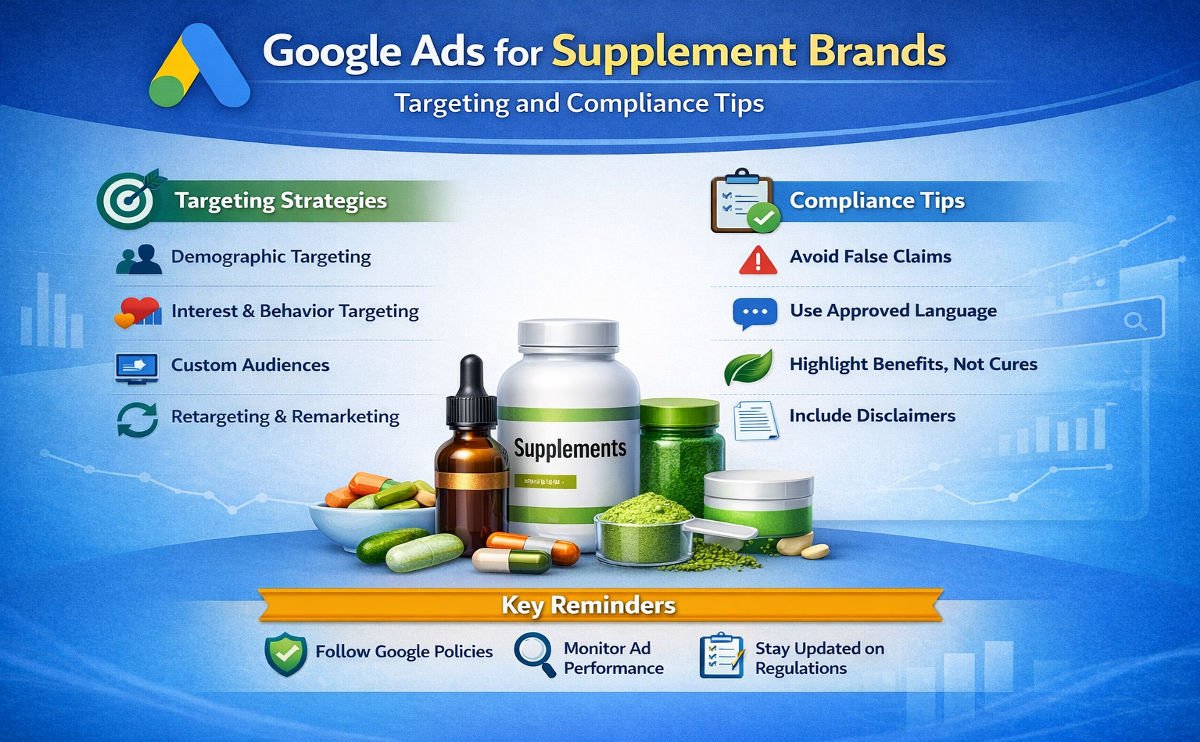
Google Ads for Supplement
Google advertising supplements can be one of the quickest methods to scale your brand, provided that you do it correctly. Don’t get interrupted in scrolling like on social platforms; Google grabs high-intent buyers who are actively searching to find solutions.
But there’s a catch.
Advertising on supplements is in a delicate position. Amongst strict policies, medical claims limits, and increasing competition, brands that do not comply or have a targeting strategy frequently burn money quickly.
This guide will also dissect smart targeting strategies, the health essentials of Google Ads compliance health, and tips on how to grow your supplement brand profitably in 2026, with actionable Google Ads tips 2026 on how to do it.
How Google Ads performs so well with Supplements.
When someone types:
● “best magnesium for sleep”
● testosterone booster, natural.
● “supplement for gut health”
● Ashwagandha capsules in my area
They already have intent.
That’s the power of Google Ads for supplements. You are not making someone see that he or she has a problem; you are providing a solution and the person is seeking it and eager to find it.
To the e-commerce brands, this makes the use of Google Ads targeting e-commerce utterly strong, particularly to:
● High-intent keywords
● Brand protection campaigns
● Competitor targeting
● Shopping ads
Step 1: Google Ads Compliance For Health Products.
Google Ads Compliance Health Rules — Before scaling anything, learn about it.
The policies of Google are strict concerning:
● False pharmaceutical claims.
● Misleading health claims
● Dangerous products
● Exaggerated results
● Before-and-after imagery
What You Cannot Say
Avoid phrases like:
● “Cures anxiety”
● “Reverses diabetes”
● “Treats depression”
● “Guaranteed weight loss”
What You Can Say
Use structure like:
● “Supports healthy mood”
● Promotes metabolic functioning.
● Helps keep my joints comfortable.
● This is labeled as an immune health formulation.
The distinction is very subtle – but vital.
Violations can lead to:
● Ad disapproval
● Account suspension
● Permanent bans
In the case of Google Ads for supplements, there is no choice but to adhere to it or perish.
Action 2: Begin with High-Intent Search Campaigns.
Make it simple, especially when you are new.
Begin with:
Precise and Phrase Match Keywords.<
Focus on:
● “Buy magnesium glycinate”
● best collagen powder for women.
● Ashwagandha capsules of organic quality.
These keywords are more converting as the user is closer to buying.
Unless you have good negative keyword lists, do not use broad match at the start.
Brand Campaigns (Guard Your Traffic)
You should always advertise under your brand name.
Why?
Since the competitors will have an option to bid on your brand keywords.
A simple branded campaign:
● Low cost per click
● High conversion rate
● Defends your space
This is also among the easiest yet least known Google Ads tips 2026.
Step 3: Google Ads for Ecommerce (Shopping Ads)
Physical supplements can be ideal works of the Shopping Ads.
They display:
● Product image
● Price
● Reviews
● Store name
They are effective since they pre-qualify the buyer prior to the click.
To succeed with Shopping ads:
● Maximize product names using keywords.
● Use clean product images
● Add proper descriptions.
● Add GTINs when available
In the case of Google Ads targeting e-commerce, Shopping ads tend to be the channel with the highest ROI.
Step 4: Targeting of the Smart Audience
Google is not only about keywords anymore.
You can layer in:
In-Market Audiences
Active researchers of target people:
● Vitamins & supplements
● Weight loss products
● Fitness nutrition
Custom Intent Audiences
Build audiences based on:
● Competitor URLs
● Specific search terms
Remarketing Lists
Target:
● Website visitors
● Cart abandoners
● Past buyers
● Email subscribers
Remarketing plays a crucial role in the case of supplements, as most people who buy them compare the brands before they buy.
Step 5: Optimize Your Landing Pages for Compliance & Conversions.
Although your copy of the ad may be built and is in compliance with the Google Ads compliance health requirements, your landing page should be in compliance as well.
Common mistakes:
● Medical boasts in the headlines.
● Fake testimonials
● Unverified clinical claims
● Violent pre and post-pictures.
On your first page, you have to include:
● Obvious advantages (non-medical claims).
● Ingredient transparency
● Third-party testing info
● Real customer reviews
● FAQ section
● Clear refund policy
Google looks at what you really are going through and not only what you write in your ad.
Step 6: Conversion Tracking & Smart Bidding.
Automation is more robust in 2026.
After you have collected sufficient data (30-50 conversions per month) test:
● Maximize Conversions
● Target CPA
● Target ROAS
However, at the beginning, the manual CPC is more controlling.
The most significant of the Google Ads tips 2026:
Give the algorithm the correct conversion data. Lack of performance means lack of tracking.
Step 7: Save Money on Negative Keywords.
Supplements are a subject of irrelevant searches.
Add negative keywords like:
● “free”
● “DIY”
● side effects (depending on product)
● “research paper”
● “Wikipedia”
● And then there is Amazon (unless it competes there)
One of the quickest methods of managing ROI in the case of Google Ads for supplements is negative keyword management.
Step 8: Competitor & Comparison Targeting.
People searching:
● “Brand A vs Brand B”
● “Is X supplement legit?”
● “Best alternative to…”
These are high-converting queries.
Prepare comparison landing pages which:
● Highlight your strengths
● Display ingredient transparency.
● Avoid false claims
● Stay factual
This is a sophisticated Google Ads targeting e-commerce plan that will boost the conversion rates.
Step 9: Strategy of Allocation of the Budget.
Assuming that you have a starting point of 3,000/month, consider:
● 40% Shopping
● 30% Non-brand Search
● 20% Brand Search
● 10% Remarketing
Scale what works.
Step 10: Keep up with Policy Change.
Google changes health advertising policies on a regular basis.
Make it a habit to:
● Quarterly review of policy changes.
● Monitor disapproval alerts
● Have alternative reserve ad accounts (legal organizations).
● Keep records of certifications.
In the case of the supplement brands, compliance awareness falls under marketing.
Final Thoughts
Google Ads will still be one of the most potent growth engines of supplement brands in 2026.
The winning formula:
● Strict compliance with Google Ads compliance health.
● Target high-intention keywords.
● Use Shopping campaigns
● Establish powerful remarketing channels.
● Optimize landing pages
● Smart bidding after enough data.
When used properly, Google Ads for supplements not only drives traffic, but it also sells willing-to-buy customers.
Frequently Asked Questions (FAQ)
Are Google Ads for supplements allowed?
Yes, but you have to comply with tough health advertising guidelines. Do not make medical claims and empty promises.
Which is the most effective campaign that supplement brands can use?
Search campaigns with high intent, as well as shopping, tend to work best in the case of e-commerce supplement stores.
How do I avoid ad disapproval?
Adhere to the health standards of Google Ads compliance health:
● Avoid disease claims
● Use support-based language
● Make sure that landing pages are equal to ad copy.
How much money do I need to begin with?
The starting point of many brands is at 50-100 per day. Scaling is reliant on product margins and conversion rates.
Does broad match suit supplements?
It is capable of working when you possess great negative keyword lists and sufficient data. Novices must commence with a phrase.